
Introduction to evaluations
What is an evaluation?
Section titled “What is an evaluation?”An evaluation allows a student to demonstrate competencies in a variety of settings. Depending on the type of evaluation, the student can be evaluated by an instructor, another student, or a preceptor.
Evaluation types
Section titled “Evaluation types”EMCE supports multiple types of evaluations, which allow students to first demonstrate individual skills, progress to demonstrating multiple skills during a simulated patient encounter, and eventually work with real patients during a shift in a hospital or ambulance.
Skill evaluations
Section titled “Skill evaluations”The student demonstrates proficiency in performing a particular skill in a classroom or lab setting.
- Paramedics may also need to document Isolated Live skills in the field or clinic. For example, if the student is asked to administer an IV on a patient to which they’re not otherwise performing an interview, exam, or other type of comprehensive care.
- The student may be evaluated by an instructor or another student.
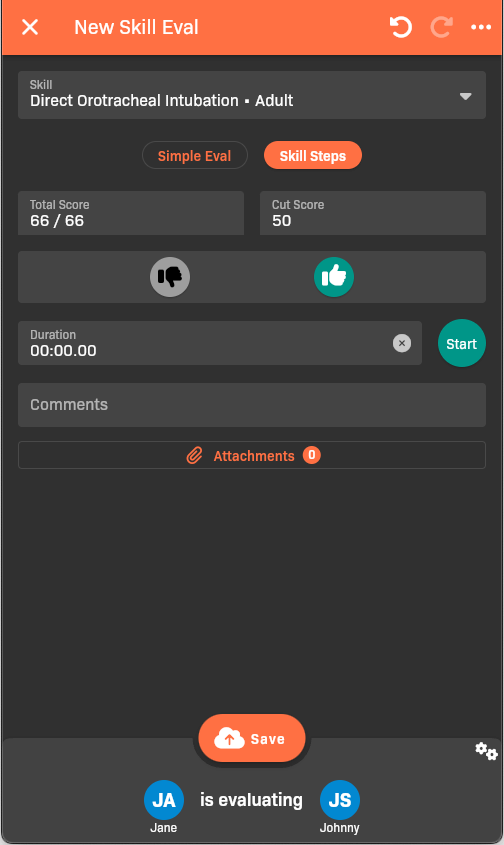
New skill evaluation
See Skill Evaluations for more information.
Patient evaluations
Section titled “Patient evaluations”The student participates in a patient encounter, real or simulated, during which they demonstrate proficiency in one or more skills.
- Simulations can be solo simulated patient evaluation or simulation session. The student may be evaluated by an instructor or another student.
- Non-simulated patient encounters must be recorded as a part of a shift evaluation. The student may be evaluated by an instructor or preceptor.
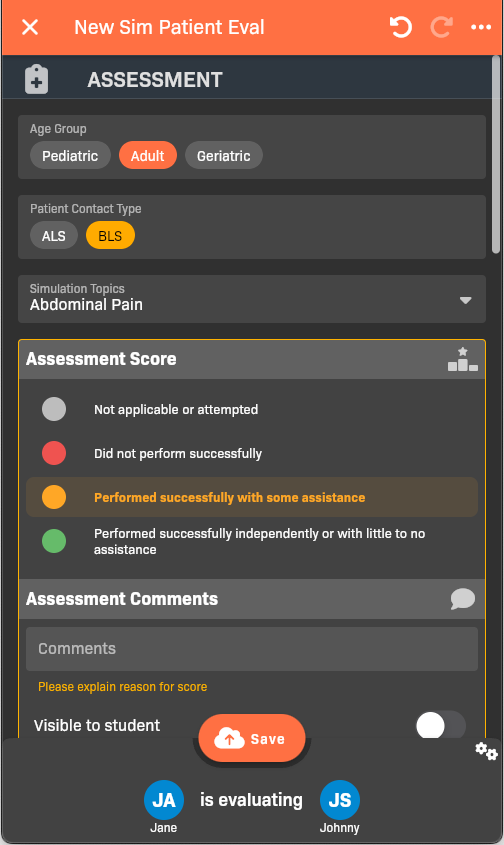
New simulated patient evaluation
See Simulated Patient Evaluations for more information.
Shift evaluations
Section titled “Shift evaluations”The student works a shift at a hospital (clinic) or in an ambulance (field), during which they provide care for real patients, demonstrating proficiency in multiple skills. The student may be evaluated by an instructor or a preceptor.
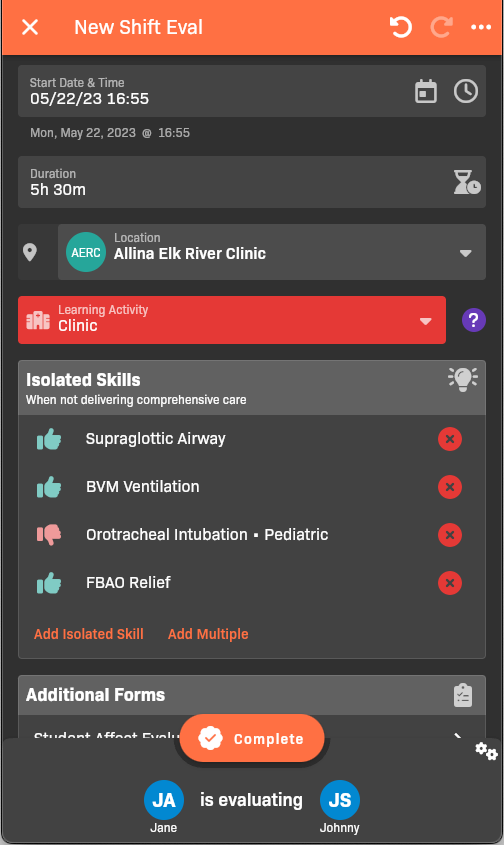
New shift evaluation
See Shift Evaluations for more information.
Evaluation details
Section titled “Evaluation details”Simple Evaluations
Section titled “Simple Evaluations”Simple evals include an overall success rating (successful or unsuccessful)l, and comments. Comments should be entered for unsuccessful ratings.
.png)
Simple evaluation
Detailed Evaluations
Section titled “Detailed Evaluations”These evaluations are based on NREMT or AHA forms and include:
- Scores for each step
- Total numeric score (the sum of all skill step scores)
- Cut score (the minimum score needed to be considered successful)
- Critical criteria, which if marked, performance should be considered unsuccessful
- Overall success rating
- Comments
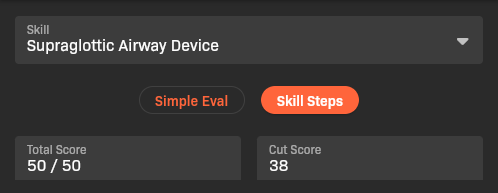
Detailed evaluation
Switching between eval types
Section titled “Switching between eval types”Evaluations default to simple mode. To switch to detailed eval, tap Skill Steps.
.png)
Detailed evaluation
Once Skill Steps are opened, you may switch back to a simple eval by tapping on Simple Eval. This will delete any scores that have been entered.
: A single student is evaluated on skill performance within the context of a simulated patient.
: A team of students provide care for a single simulated patient.
: A medical professional that the student is shadowing in a real hospital or ambulance setting.